

What Is an Authority Content Engine and Why Does It Matter for B2B Growth?
An authority content engine is a systematic framework that transforms founder expertise into content assets that establish market authority, capture search intent, and generate qualified pipeline. Unlike sporadic content creation or random social posting, an authority content engine operates as business infrastructure—converting your unique perspective into predictable revenue. According to the 2024 Edelman-LinkedIn B2B Thought Leadership Impact Study, 73% of decision-makers trust thought leadership content over marketing materials, and 90% become more receptive to sales outreach from companies producing high-quality authority content.
The Strategic Foundation of Authority Content Marketing
Building an authority content engine isn’t about publishing more blog posts or flooding LinkedIn with hot takes. It’s about creating a repeatable system that converts your lived experience, unique frameworks, and hard-won insights into assets that compound over time. The Ehrenberg-Bass Institute research reveals that 95% of B2B buyers aren’t actively shopping at any given time—which means your content must reach the vast out-of-market audience who will become in-market later. Authority content does exactly that: it builds trust before the buying window opens.
This guide breaks down exactly how to build your own authority content engine from the ground up. You’ll learn the frameworks top agencies use, the tools that measure authority, the platforms that drive B2B engagement, and the specific tactics that turn founder expertise into pipeline. Whether you’re a seed-stage founder competing against better-funded competitors or a Series A company ready to scale your content operations, this blueprint gives you the infrastructure to build sustainable competitive advantage through content.
What Is Authority Content? Understanding the Meaning Behind Authority Building Content
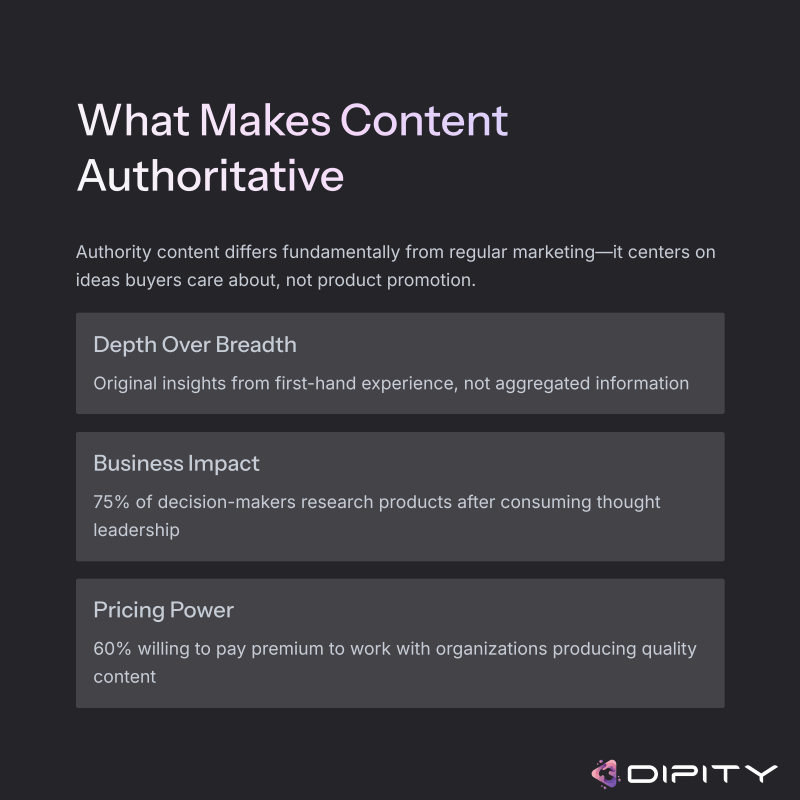
Authority content differs fundamentally from regular content marketing. Forrester defines thought leadership as content that “centers on an idea that buyers care about and that the company can meaningfully contribute to”—explicitly distinguishing it from promotional content about products or services. This distinction matters because authority content builds long-term brand equity through ideas buyers actually care about, while regular content marketing often optimizes for short-term lead generation.
The 2024 Edelman-LinkedIn study defines thought leadership as “content that offers expertise, guidance or a unique point of view on a topic or in a field.” What makes authority content different is its orientation toward depth over breadth, original insights over aggregated information, and first-hand experience over theoretical frameworks.
The business impact of authority content marketing is substantial. The same Edelman-LinkedIn research found that 75% of decision-makers say thought leadership led them to research a product or service they weren’t previously considering. Even more compelling: 60% of decision-makers say quality authority content makes them willing to pay a premium to work with that organization. For early-stage startups competing against incumbents with deeper pockets, this pricing power represents a meaningful competitive advantage.
Authority content also creates defensive moats. According to the research, 70% of C-suite leaders say thought leadership has led them to question whether they should continue with an existing supplier—and 25% of those who questioned their supplier ended or significantly reduced that relationship. Your authority content engine doesn’t just win new business; it protects against competitive displacement.
How Do Top Marketing Companies Create Authority Content for B2B Brands?
The most effective B2B content agencies share common methodologies that separate authority content from commodity content. Understanding these frameworks helps you build systems that actually work—whether you’re working with an agency or building in-house.
Movement-First Content Strategy
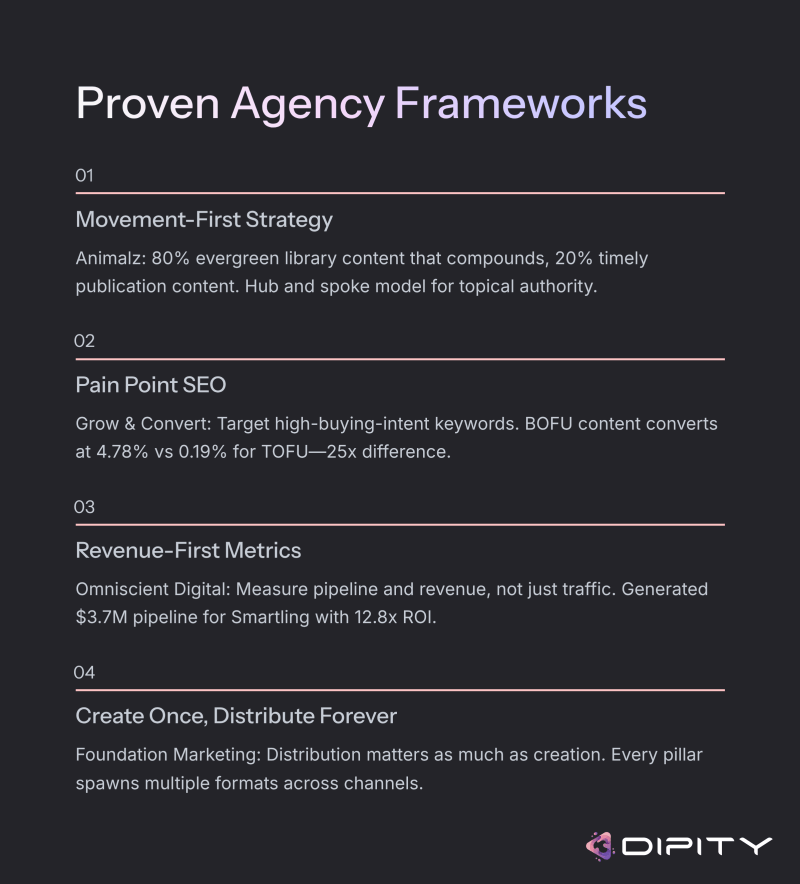
Animalz pioneered the Library vs. Publication framework, recommending 80% evergreen “library” content that compounds over time, paired with 20% timely “publication” content that captures moment-driven attention. Their Hub and Spoke model centers pillar content targeting competitive keywords, surrounded by supporting articles on subtopics—all interconnected to build topical authority. This approach has driven results for clients including Google, Intercom, and Zendesk.
Pain Point SEO
Grow & Convert developed Pain Point SEO—targeting high-buying-intent keywords over high-volume keywords. Their Bottom-of-Funnel first approach prioritizes conversion-focused content, recognizing that a page ranking for “Salesforce alternatives” delivers more pipeline value than one ranking for “what is CRM.” Their data shows BOFU content converts at 4.78% compared to just 0.19% for top-of-funnel content—a 25x difference in conversion efficiency.
Revenue-First Metrics
Omniscient Digital measures pipeline and revenue rather than just traffic. Their “Barbell” content strategy indexes heavily on low-risk keyword-driven content while experimenting with high-risk, high-payoff pieces. This approach generated $3.7 million in pipeline value for Smartling with a 31,250% increase in blog conversions and 12.8x ROI on their agency investment.
Create Once, Distribute Forever
Ross Simmonds at Foundation Marketing built his agency around the principle that distribution matters as much as creation. Their 4-pillar framework—Research, Creation, Distribution, Optimization—emphasizes that great content fails without systematic distribution. Every pillar piece should spawn multiple LinkedIn posts, Twitter threads, newsletter editions, and short-form video clips.
The common thread across these agencies: they treat content as a revenue system, not a marketing activity. Content pillars map to business objectives. Distribution is systematized, not ad hoc. And measurement connects content performance to pipeline outcomes—not just vanity metrics like pageviews and social shares.
Which Agencies Specialize in Producing Authority Content for Startups?
Selecting the right content partner depends on your stage, budget, and specific needs. Here’s how the landscape breaks down for seed-to-Series-B startups:
Enterprise-Grade Thought Leadership
Animalz focuses on movement-first content for established SaaS companies. Their strength is creating category-defining narratives that position clients as market leaders. Best for Series B+ companies with established product-market fit seeking to own their category narrative.
SEO-Driven Growth
Siege Media combines content with design, using their proprietary KOB (Keyword Opposition to Benefit) Analysis to identify high-impact opportunities. They’ve generated approximately $7.4 million per month in client traffic value, with case studies showing 1,039% traffic value increases for clients like Figma.
Product-Led Content
Grizzle specializes in product-led content that teaches readers how to solve problems using your product’s features. Their on-demand subscription model with flexible credits works well for post-Series A startups with product-market fit looking to scale content efficiently.
Founder-Led Authority Systems
At Dipity Digital, we built the Authority Content Engine™ specifically for seed-to-Series-A AI and B2B tech startups. Our approach integrates competitive intelligence, founder voice extraction, high-intent search strategy, multi-channel distribution, and closed-loop measurement into a unified system. We’ve helped clients like Klover.ai scale from zero to 500+ published articles with an average Google rank of 6.3 and strong presence in AI answer engines.
The key differentiator for early-stage startups: you need a partner who understands that founder voice is the moat. Generic brand content can’t compete with thought leadership that encodes your unique perspective, frameworks, and hard-won insights. Look for agencies that prioritize founder interviews, voice extraction, and systematic capture of your expertise—not just content fulfillment.
Where Can I Find Case Studies on Authority Content Strategies by Leading Firms?
Real case studies with verified metrics separate proven approaches from theoretical frameworks. Here are documented examples of authority content strategies delivering measurable business outcomes:
Smartling: $3.7M Pipeline from Authority Content
Omniscient Digital’s work with Smartling demonstrates the revenue impact of systematic authority content. The translation management platform achieved $3.7 million in pipeline value from organic search, a 31,250% increase in blog conversions, and 12.8x ROI on their content investment. The approach combined comprehensive topic cluster coverage with conversion-focused content targeting high-intent keywords.
Jasper: $4M+ ARR Attributed to Content
The AI writing tool achieved 810% growth in organic blog sessions and over $4 million in ARR directly attributed to content efforts. Their content strategy focused on building topical authority around AI writing use cases while capturing emerging search demand in the generative AI space.
Authority Content Engine™ in Action
Our work at Dipity Digital with Klover.ai shows how the Authority Content Engine™ framework scales for AI startups. Starting from scratch, we built a comprehensive content operation producing 500+ articles over six months, achieving an average Google ranking position of 6.3 and establishing strong visibility in AI-powered answer engines like Perplexity and ChatGPT.
The pattern across these case studies: authority content works when it’s systematic, measured against pipeline metrics, and optimized for how buyers actually research solutions. Sporadic publishing without measurement produces sporadic results.
What Tools Help Analyze the Authority Score of Online Content?
Measuring authority requires the right toolkit. Here’s what founders should use to track and improve their content’s authority signals:
Domain and Backlink Authority
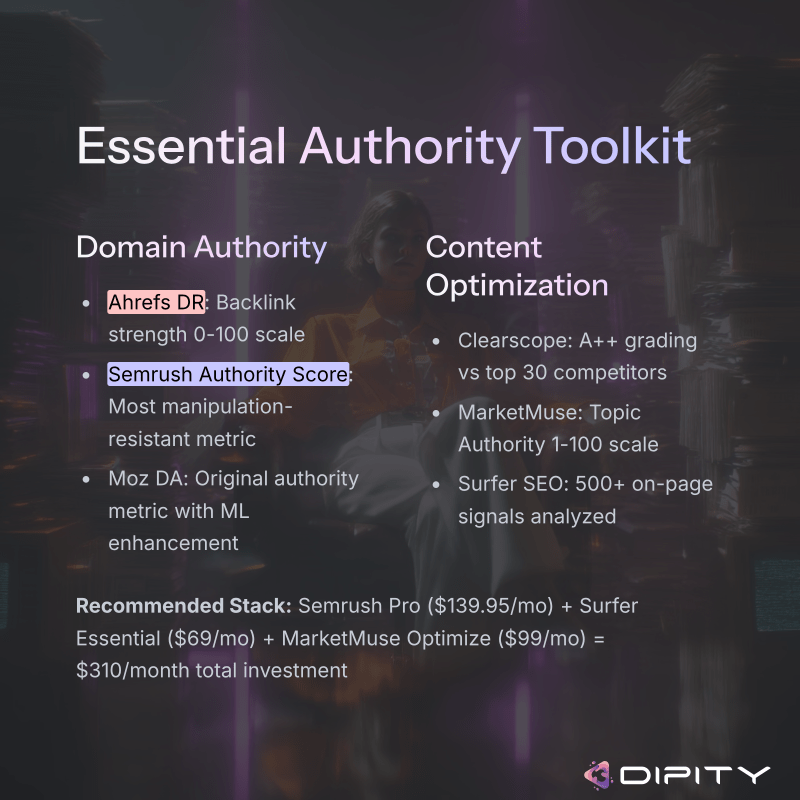
- Ahrefs Domain Rating (DR) measures backlink profile strength on a logarithmic 0-100 scale. Only dofollow links count, and fewer than 0.007% of domains achieve DR 80+. Ahrefs also offers Content Explorer for finding top-performing content in your niche and Content Gap Analysis to identify keywords competitors rank for that you don’t. Pricing starts at $129/month for Lite, scaling to $249/month for Standard which includes keyword clusters.
- Semrush Authority Score combines Link Power, Organic Traffic, and Spam Factors into a compound metric updated every two weeks. It’s considered the most manipulation-resistant authority metric available. Semrush also tracks your visibility in AI answer engines through their AI toolkit. Pricing runs $139.95/month for Pro, with Guru at $249.95/month for larger operations.
- Moz Domain Authority (DA) was the original domain authority metric, now enhanced with machine learning in DA 2.0. While less commonly used than Ahrefs or Semrush, it remains a useful reference point. Pricing starts at $49/month for Starter.
Content Optimization and Topical Authority
- Clearscope grades content A++ based on relevance against top-ranking competitors. It analyzes Google’s top 30 results and suggests 60+ relevant keywords to include. Many enterprise content teams use Clearscope as their standard for content quality. Pricing starts at $189/month for Essentials.
- MarketMuse offers a Topic Authority metric measuring your site’s coverage breadth on a 1-100 scale. Their Personalized Difficulty feature calculates keyword difficulty based on your existing authority—not just the competitive landscape. This helps identify topics where you can compete despite lower overall domain authority. Free tier available, with Optimize at $99/month.
- Surfer SEO provides a Content Score (0-100) based on 500+ on-page signals analyzed in real-time. Their Topical Map feature helps you plan comprehensive topic cluster coverage. Essential tier runs $69/month when billed annually.
Recommended Stack for B2B Startups
For seed-to-Series-A companies, I recommend: Semrush Pro ($139.95/month) for keyword research and authority tracking, Surfer SEO Essential ($69/month) for content optimization, and MarketMuse Optimize ($99/month) for topical authority planning. Total investment: approximately $310/month for a comprehensive authority measurement toolkit.
What Are the Most Effective Content Management Systems for Managing Authority Content?
Your CMS choice impacts SEO performance, schema markup capabilities, and scalability. Here’s how the options stack up for authority content operations:
WordPress
WordPress remains the most flexible option for authority content. With plugins like Rank Math offering 20+ schema types in the free version, you get enterprise-grade structured data without enterprise costs. WordPress handles millions of pages with proper managed hosting from providers like WP Engine or Kinsta. Cost: Free core plus $30-300/month for managed hosting and $59-99/year for premium SEO plugins.
Webflow
Webflow provides good built-in SEO capabilities including meta tags, XML sitemaps, 301 redirects, and fast CDN delivery. Schema markup requires manual JSON-LD implementation, though Webflow AI can auto-generate on paid plans. CMS Plan handles 2,000 items at $23/month, with Business scaling to 20,000 items at $39-89/month. Best for design-focused startups wanting visual control without code.
HubSpot CMS
HubSpot Content Hub offers built-in SEO recommendations and topic cluster tools at the Professional tier. The tight integration with HubSpot CRM enables closed-loop attribution between content and pipeline. However, advanced schema requires custom development. Starter runs $20-25/month per seat, but Professional (where the real features live) costs $400-500/month for 3 seats.
Ghost
Ghost delivers excellent SEO out of the box—automatic meta tags, canonical URLs, and speeds up to 19x faster than WordPress. Built-in Article schema covers basics; custom schema requires code injection. Pricing: Starter at $18/month, Publisher at $29/month, Business at $199/month. Best for content-focused startups and newsletter-first businesses.
Headless Options (Contentful, Sanity)
Headless CMS platforms like Contentful offer maximum flexibility but require developer implementation for SEO. No built-in optimization tools exist—everything must be custom-built on the frontend. Best for tech-forward startups with dedicated developer resources and multi-channel content needs. Be aware that JavaScript rendering issues can impact SEO if not implemented carefully.
My recommendation by stage: Seed ($0-50/month) should use WordPress with free hosting and Rank Math. Series A ($100-500/month) should consider WordPress with managed hosting plus Rank Math Pro, or Webflow Business. Series B+ ($500+/month) can evaluate HubSpot Professional if CRM integration matters, or WordPress Enterprise hosting for maximum flexibility.
What Are the Best Platforms to Publish Authority Content for Tech Startups?
Distribution determines whether your authority content builds pipeline or collects dust. Here’s where B2B buyers actually engage with thought leadership:
LinkedIn: The Primary B2B Channel
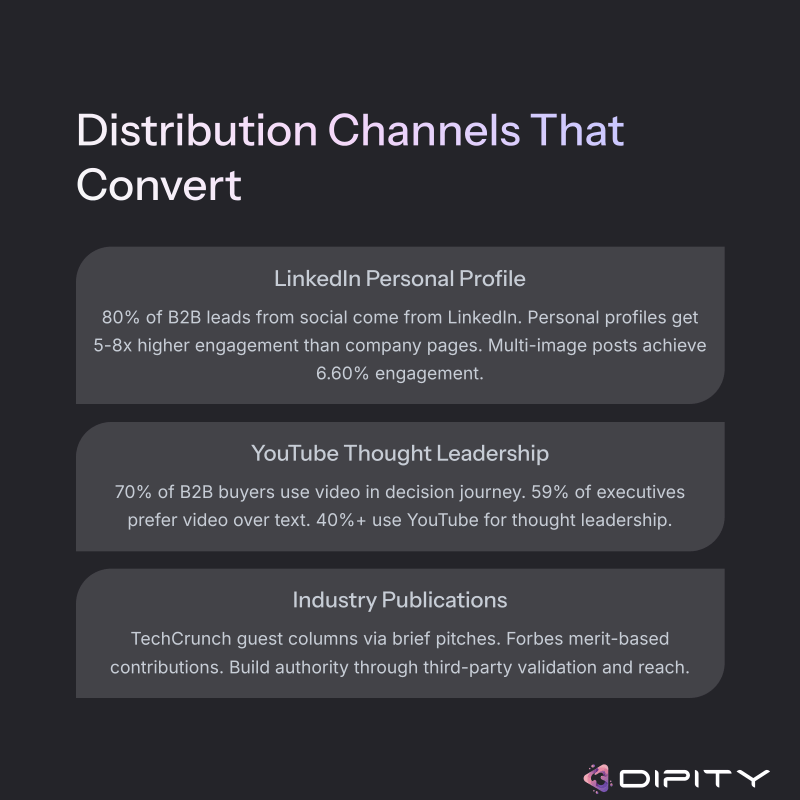
The numbers make LinkedIn indispensable for B2B authority building. LinkedIn data shows 4 out of 5 members drive decision-making at their organization, with 40 million members in decision-making positions and 10 million C-level executives on the platform. More critically, 80% of B2B leads from social media come from LinkedIn.
Personal profiles dramatically outperform company pages. According to Socialinsider’s 2024 LinkedIn benchmarks, multi-image posts achieve 6.60% engagement (highest of any format), native documents and carousels hit 5.85%, and video reaches 5.60%. Research from Column Content shows personal profiles generate 5-8x higher engagement than company pages—the algorithm literally favors human faces over logos.
Strategy: Use founder personal profiles as your primary distribution channel (3-5 posts weekly minimum). Maintain a company page for brand establishment but don’t expect organic reach. Consider LinkedIn Newsletters—there are 36,000+ actively published with 29 million+ subscribers, and each edition sends push notifications to subscribers while getting indexed in Google search.
Industry Publications
TechCrunch accepts guest columns via pitches to guestcolumns@techcrunch.com. Send brief pitches (2-3 sentences) with proposed headlines—not full articles. Topics should offer actionable advice from real experience on management, growth, fundraising, or emerging tech trends.
Forbes operates two contributor paths: merit-based pitches to ideas@forbes.com (free to publish) and Forbes Councils (pay-to-play at $1,900-$5,000+ annually). Important note: joining Forbes Councils permanently disqualifies you from becoming a regular contributor. Choose your path carefully.
YouTube for B2B Thought Leadership
Video continues gaining B2B adoption—70% of B2B buyers use video in their decision journey, and 59% of senior executives prefer video over text. Over 40% of B2B businesses use YouTube primarily for establishing thought leadership through how-to videos, explainer content, thought leadership interviews, and webinar recordings.
My platform priority for tech startups: Tier 1 (must-have) includes LinkedIn personal profile, LinkedIn newsletter, and company blog. Tier 2 (growth) adds YouTube, podcasting (as host or guest), and Medium syndication with canonical tags. Tier 3 (authority building) includes industry publications like TechCrunch and VentureBeat.
Building Authority for Search: E-E-A-T and Answer Engine Optimization
Google’s evaluation framework and the rise of AI-powered search both reward the same thing: demonstrated authority from real experts. Understanding these systems helps you build content that ranks in traditional search and gets cited by AI answer engines.
Google’s E-E-A-T Framework
E-E-A-T stands for Experience, Expertise, Authoritativeness, and Trustworthiness—with Trust being the most critical component. Google explicitly states that untrustworthy content has low E-E-A-T regardless of expertise level. The framework guides both algorithmic signals and Google’s 16,000+ human quality raters who evaluate content.
Experience (the newest component) values first-hand, real-world involvement with subject matter. Evidence that suggestions have been tried and tested matters—original photos, videos, and media demonstrating actual use signal experience that aggregated research cannot replicate.
Expertise encompasses formal credentials, depth of knowledge, and subject-matter qualifications. For B2B content, this means clear author bylines with credentials, detailed author pages linking to social profiles and other published work, and citations from reputable sources.
Authoritativeness depends on what others say about you—backlinks from authoritative sites, press mentions, peer citations, and branded search volume indicating user recognition. Off-site validation matters as much as what you claim about yourself.
Answer Engine Optimization (AEO)
AI-powered search is fragmenting the citation landscape. According to Omniscient Digital’s AI SEO research, there’s only about 11% overlap in citations between major AI platforms—meaning 89% of citations come from completely different sources depending on which AI model processes the query. Google AI Overviews appear for approximately 12% of searches overall, but up to 50-70% for healthcare queries.
Answer Engine Optimization requires specific content structures. Lead with direct answers (40-60 words) immediately after question-based headings. Use bullet points and numbered lists—78% of AI Overviews include lists. Keep paragraphs to 2-3 sentences and sentences under 20 words. Structure content for extraction: FAQ sections, step-by-step tutorials, comparison articles, and definition content all get cited more frequently.
Schema markup signals authority to both traditional search and AI systems. Prioritize FAQPage schema for Q&A sections, HowTo schema for instructional content, Article/BlogPosting with full author markup, and Organization schema site-wide. Our guide on why schema markup is the new growth hack for lean startups covers implementation details.
What Authority Do You Have Over This Account and Content? Taking Control
The question “what authority do you have over this account and content” reflects a fundamental truth: authority comes from systematic execution, not sporadic inspiration. Building your authority content engine requires implementing the frameworks above into a repeatable system.
The 90-Day Proof of Concept
Days 1-30: Establish your baseline with 5 LinkedIn posts weekly from the founder’s personal account, 20 minutes of daily engagement with ICP content, basic performance tracking (impressions, engagement rate, inbound messages), and weekly iteration based on what resonates.
Days 31-60: Double down on top-performing content themes. Add content repurposing (LinkedIn posts become newsletter editions, voice memos become blog posts). Implement UTM tracking for attribution. Begin measuring pipeline influence from content.
Days 61-90: Scale through team support (ghostwriter or content coordinator). Add secondary distribution channels (newsletter or podcast). Implement full attribution in your CRM. Calculate ROI to justify further investment.
Success Benchmarks
Track follower growth trajectory (expect 20-30% monthly growth with consistent execution), engagement rate improvement (3-5% is strong for B2B), inbound message volume (target 10-20% increase monthly), and pipeline attribution (aim for 20-30% of demos influenced by content within 6 months).
The Authority Content Engine™ works because it aligns with how B2B buyers actually make decisions. The 2024 Edelman-LinkedIn research confirms that 86% of decision-makers will invite organizations producing quality thought leadership to RFP processes—and 52% spend an hour or more per week consuming this content. Your buyers are actively looking for authority they can trust.
Building Authority Is Building Moats
The data is unambiguous: founder-led authority content outperforms traditional demand generation for early-stage B2B tech companies. Decision-makers trust thought leadership over marketing materials, pay premiums to work with recognized authorities, and actively research companies based on the quality of their ideas—not their ad spend.
The implementation path is clear: extract your unique expertise through systematic founder interviews, produce content following E-E-A-T principles, optimize for both human readers and AI answer engines through structured data and clear formatting, distribute consistently for 90+ days minimum, and measure ruthlessly to prove ROI.
The founders winning with this approach aren’t more talented or better funded. They’re more systematic. They’ve built infrastructure that converts expertise into pipeline predictably.
Start with one LinkedIn post this week. Document what you learned from your last customer call. Share the framework you use to solve your ICP’s biggest problem. Then do it again next week. The compound effect of systematic authority building is the closest thing to sustainable competitive advantage in modern B2B.
Your expertise is already an asset. An authority content engine makes it infrastructure.
Ready to build your own Authority Content Engine™?
Get started with our Authority Architecture™
Frequently Asked Questions
How long does it take to see results from an authority content engine?
Most founders see measurable engagement improvements within 30-60 days of consistent execution. Pipeline attribution typically becomes visible within 90-180 days. The 2024 Edelman-LinkedIn research shows that 23% of executives who research a product after consuming thought leadership begin buying from that organization—but building the trust that drives that research takes consistent presence over months, not weeks.
What’s the minimum investment required to build an authority content engine?
You can start with zero budget beyond your time: founder LinkedIn posts (free), basic CMS like WordPress (free), and manual content tracking. Adding tools like Semrush, Surfer SEO, and MarketMuse runs approximately $310/month. Full-service agency support for authority content typically ranges from $6,500-$22,500/month depending on scope and production volume.
Should I prioritize SEO content or social content for authority building?
Both serve different functions in the authority engine. SEO content captures demand from buyers actively researching solutions—high intent but lower volume. Social content (especially LinkedIn) builds awareness with the 95% of buyers not currently shopping but who will become in-market later. The most effective approach integrates both: pillar SEO content repurposed into social formats for distribution.
How do I measure ROI on authority content?
Track leading indicators (impressions, engagement rate, follower growth), mid-funnel metrics (demo requests, content-assisted opportunities in CRM), and revenue outcomes (pipeline influenced by content, deals where content appeared in buyer journey). Only 29% of companies currently link leads to specific content pieces—implementing basic UTM tracking and CRM attribution gives you significant competitive advantage in measurement.
Can AI-generated content build authority?
AI can assist with research, outlining, and first drafts, but authority content requires genuine expertise and original insights that AI cannot fabricate. Google’s E-E-A-T framework explicitly values Experience—first-hand knowledge that demonstrates you’ve actually done what you’re writing about. The most effective approach uses AI to scale founder expertise (transcribing interviews, repurposing formats, research synthesis) while keeping the unique perspective and lived experience at the core. Content that reads like everyone else’s AI output builds no authority.
Works Cited
Ahrefs. (2024). Domain Rating: What It Is & What It’s Good For. Retrieved from https://ahrefs.com/blog/domain-rating/
Animalz. (2025). 17 Flagship Frameworks From 10 Years of Animalz Content. Retrieved from https://www.animalz.co/blog/flagship-content-frameworks
Animalz. (2025). The 9 Best B2B SaaS Content Marketing Agencies in 2025. Retrieved from https://www.animalz.co/blog/b2b-saas-content-marketing-agencies
Backlinko. (2024). Google E-E-A-T: How to Create People-First Content. Retrieved from https://backlinko.com/google-e-e-a-t
Brainsell. (2024). CMS Pricing: How Much Does HubSpot Cost? Retrieved from https://www.brainsell.com/blog/hubspot-cms-pricing/
ClearVoice. (2024). Google E-E-A-T. Retrieved from https://www.clearvoice.com/resources/what-is-googles-eeat/
Column Content. (2024). LinkedIn Company Page vs. Personal Profile: Which Is Better? Retrieved from https://columncontent.com/linkedin-company-page-vs-personal-profile/
Edelman-LinkedIn. (2024). B2B Thought Leadership Impact Report 2024. Retrieved from https://www.edelman.com/sites/g/files/aatuss191/files/2024-02/_2024%20Edelman-LinkedIn%20B2B%20Thought%20Leadership%20Impact%20Report%20Final.pdf
Flyerone. (2024). Forbes, WIRED, TechCrunch: How to pitch your columns to renowned media. Retrieved from https://flyerone.vc/post/how-to-pitch-your-columns-to-media
Forrester. (2024). The Trouble With Thought Leadership. Retrieved from https://www.forrester.com/what-it-means/ep274-b2b-thought-leadership/
Garit Boothe Digital. (2023). Clearscope Review: Is It Worth Paying For? Retrieved from https://garitboothe.com/clearscope-review
Ghost. (2024). Ghost(Pro) – Official managed hosting for Ghost. Retrieved from https://ghost.org/pricing
Grow and Convert. (2024). Pain Point SEO: How to Produce SEO Content That Drives Conversions. Retrieved from https://www.growandconvert.com/seo/pain-point-seo/
Growth Advisor. (2025). Google SGE Optimization: Complete AI Overview SEO Guide. Retrieved from https://growthadvisor.in/sge-optimization/
Grizzle. (2024). B2B Content Services. Retrieved from https://grizzle.io/
MarketMuse. (2024). Pricing. Retrieved from https://www.marketmuse.com/pricing/
Nick Wolny. (2025). How to Write for Forbes in 4 Steps. Retrieved from https://nickwolny.com/how-to-write-for-forbes/
Omniscient Digital. (2024). Smartling Case Study. Retrieved from https://beomniscient.com/case-studies/smartling/
Omniscient Digital. (2025). 30 AI SEO Statistics: Strategy, Trust, and Earning Citations in AI. Retrieved from https://beomniscient.com/blog/ai-seo-statistics/
Semrush. (2024). What Is Semrush’s Authority Score? Guide + Improvement Tips. Retrieved from https://www.semrush.com/blog/semrush-authority-score-explained/
SEOptimer. (2024). Surfer SEO Review & Pricing. Retrieved from https://www.seoptimer.com/blog/surfer-seo-review-pricing/
Siege Media. (2024). SaaS Organic Growth Agency. Retrieved from https://www.siegemedia.com/services/saas-organic-growth-agency
Socialinsider. (2025). LinkedIn Benchmarks 2025. Retrieved from https://www.socialinsider.io/social-media-benchmarks/linkedin
SocialPilot. (2024). 75+ LinkedIn Statistics to Capture More Leads. Retrieved from https://www.socialpilot.co/blog/linkedin-statistics
Surfer SEO. (2025). What is Answer Engine Optimization? 7 AEO Strategies. Retrieved from https://surferseo.com/blog/answer-engine-optimization/
Talent Bureau. (2024). Ross Simmonds. Retrieved from https://talentbureau.com/speaker/ross-simmonds/
Tilipman Digital. (2024). How to Add Webflow Schema Markup for Higher Google Rankings. Retrieved from https://www.tilipmandigital.com/resource-center/webflow-development-guides/webflow-schema-markup
Vidico. (2025). 10+ Amazing B2B Video Marketing Statistics & Latest Trends. Retrieved from https://vidico.com/news/b2b-video-marketing-statistics/
WP SEO AI. (2024). The Definitive Yoast vs RankMath Guide. Retrieved from https://wpseoai.com/blog/the-definitive-yoast-vs-rankmath-guide-7-critical-factors-for-decision-making/
Xamsor. (2024). Moz DA (Domain Authority) Explained. Retrieved from https://xamsor.com/blog/moz-da-domain-authority-explained/




You must be logged in to post a comment.