
Why is Answer Engine Optimization (AEO) becoming essential in 2025?
Answer Engine Optimization (AEO) has emerged as the strategic answer to AI-driven search.
Traditional SEO is no longer enough when today’s users are asking ChatGPT, Google’s Gemini, and Bing Copilot for answers instead of clicking web links. In April 2025, OpenAI’s ChatGPT reached 5.14 billion visits (up 182% YoY), even overtaking Wikipedia in traffic. Gartner forecasts a 25% drop in traditional search volume by 2026 as AI chatbots absorb more queries.
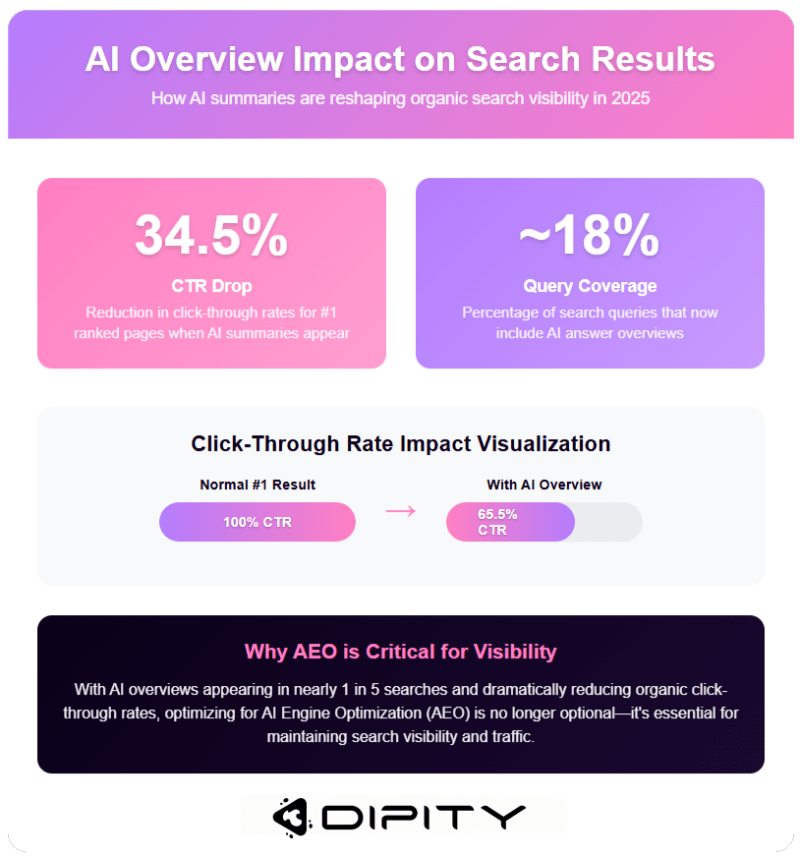
In this new paradigm, brands have to optimize content to provide the best answer, not just to appear in a search result. AI “answer engines” like SGE and Bing Chat provide instant responses, causing a steep decline in click-through rates for even #1 Google results. One analysis found nearly 65% of Google searches now end without any click because the answer is given right on the results page. In mid-2025, about 18% of searches showed AI-generated overviews, which reduced the top organic result’s clicks by 34.5% on average.
Figure 1.1: AI Overviews are increasingly common in search results and can significantly reduce click-through rates for even top-ranked pages (Ahrefs found a 34.5% CTR drop for the #1 result when an AI summary is present). Early 2025 data shows ~18% of queries now include AI answer overviews, making AEO critical for visibility.
Founders need to understand the urgency. AI answer engines are making old SEO tactics obsolete. Companies likely have a 2–3 year window to build authority in their niche before the AI content deluge makes visibility insanely difficult. Rapid shifts in digital discovery demand immediate adaptation – those who become the trusted answer sources now will dominate, while laggards risk invisibility. This is especially true for SaaS and AI startups trying to disrupt incumbents. If your content isn’t surfacing as a cited answer, you’re essentially off the radar for a growing segment of your audience.
In short, AEO is the new SEO: a necessary evolution so your brand gets picked up by AI-driven searches, not just ranked by traditional engines.
Why Answer Engine Optimization Matters for SaaS and AI Startups
Early-stage SaaS and AI tech companies can’t afford to ignore AEO – it’s a growth lever and equalizer. In the AI era, searchers expect quick, conversational answers, not a list of links. This shifts power toward quality content and authority over domain age or ad budgets. For a resource-strapped startup, a single authoritative article that an AI consistently cites can drive more qualified traffic than months of conventional SEO tweaking. Users are increasingly asking things like “What’s the best MLops platform for healthcare?” or “Top data analytics SaaS for e-commerce?” to AI assistants. If your content directly answers those questions, the AI can funnel high-intent prospects to you – even if you’re not a household name yet.
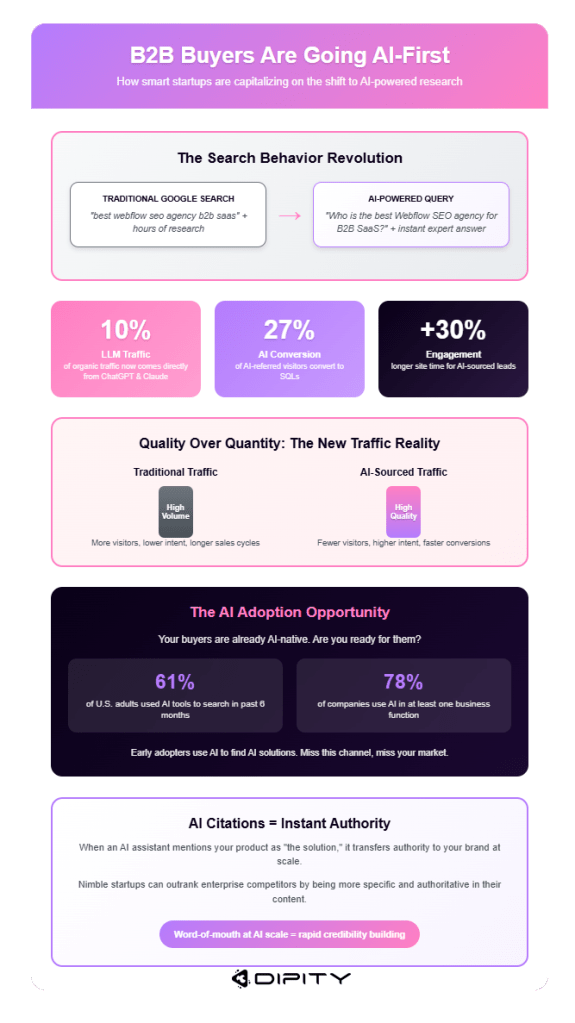
Consider the changing behavior of B2B buyers: one digital agency observed that marketing directors now go to ChatGPT with queries like “Who is the best Webflow SEO agency for B2B SaaS?” rather than combing Google. The agency’s own site saw 10% of its organic traffic come directly from LLMs like ChatGPT and Claude, and 27% of those AI-referred visitors converted into SQLs (sales-qualified leads). These AI-sourced leads also spent 30% longer on site than typical Google search visitors, meaning they arrived more engaged and informed.
The takeaway for startup founders: AI-driven traffic can be smaller in volume but higher in quality and intent, shortening sales cycles. In fact, some companies report that even as their overall traffic dips from zero-click answers, their conversion rates and revenue climb because those who do click through are highly qualified (e.g. NerdWallet grew revenue 35% despite 20% less traffic by prioritizing snippet-ready expert content).
For AI startups specifically, embracing AEO is even more critical. Your prospective customers are early adopters who use AI to find AI solutions. A 2025 survey showed 61% of U.S. adults have used an AI tool to search for information in the past six months, and 78% of companies use AI in at least one business function – meaning your buyers are primed to consume AI-curated answers. If your SaaS doesn’t appear in those AI-generated recommendations, you’re missing a big chunk of the market. On the flip side, getting cited as “the solution” by an AI engine can rapidly build credibility. It’s like word-of-mouth at scale: when an AI assistant or search overview mentions your product as a top answer, it transfers authority to your brand. Startups that adapt quickly can outrank far larger competitors inside these answer engines by being more nimble, specific, and authoritative in their content.
Figure 1.2: B2B buyers increasingly use AI assistants for discovery, driving 10% of organic traffic from LLMs, 27% higher conversion, and 30% more engagement.
Adapting Your Content Strategy for AI Answer Engine Optimization
Founders and Heads of Content must retool their content marketing to win in AI-powered search. This means they must answer the question in the first 2 sentences of every section, then provide clear context and verified data to back it up.
Here’s how SaaS and AI startups can adapt to rank in answer engines like Gemini, Bing Chat, and ChatGPT:
- Think Questions, Not Keywords: Shift your SEO research to focus on real user questions and natural language queries. Identify the exact questions your ICP (ideal customer profile) is asking at each stage of their journey.
- For example, instead of a keyword like “cloud backup SaaS”, target “What’s the most secure cloud backup for small business?”. Tools like Google’s People Also Ask, AnswerThePublic, and analyzing chatbot logs or support tickets can reveal high-value questions.
Each piece of content should answer a specific question or cluster of related questions – this increases your chances of being pulled into an AI-generated answer. In practice, top AEO performers often structure one comprehensive page to answer hundreds of related questions within a niche, covering head, mid, and long-tail queries in one authoritative guide.
- Provide Direct Answers Up Front: To get picked by an answer engine, you must satisfy the query immediately. Structure your content in a Q&A format with the question as a heading and a concise answer (40–60 words) right below. Put the direct answer in the first sentence or two of a section, then use the rest of the section to expand or provide context. This mirrors the “featured snippet” style and gives AI models a ready-to-quote passage.
- For example, if writing about “How to improve SaaS product onboarding,” start the section with: “To improve SaaS onboarding, focus on interactive tutorials and in-app guidance that show immediate value. This shortens time-to-value and reduces user drop-off.” – then continue with details.
This way, even if the AI only takes the first lines, the user gets a complete, correct answer (and your brand gets the credit). Founders should train their teams to lead with answers, not fluff.
- Optimize for Multi-Modal AI Results: AI search isn’t just text – it’s voice, chat, and even image-based. Ensure your answers are formatted for all channels. This means using speakable markup for voice assistants and concise text for chat interfaces.
- For instance, phrase key points in a way that sounds natural if read aloud (voice search is growing and often uses conversational queriescxl.com).
Additionally, provide relevant images or diagrams with descriptive alt text, because AI summaries might display visuals. If you have an instructional SaaS (say a UI tool), a quick infographic or a step-by-step image series with proper <alt> tags and Schema markup (like HowTo or VideoObject schema) can be parsed by AI to enrich answers. Being multi-modal-ready increases your chances of being the chosen answer across different AI platforms.
- Leverage AI-Friendly Schema and Metadata: Structured data is a game changer for AEO. Implement Schema.org markup liberally – include FAQPage schema for Q&A content, HowTo schema for guides, Article schema for blog posts, Product schema for product details, and Organization/Person schema for your company and founders.
This extra metadata helps AI models instantly understand who you are and what you offer. In 2025, pages using schema saw 58% higher visibility in AI search snippets than those without. Also consider new metadata: e.g. ai.txt or llms.txt files (a proposed analogue to robots.txt) to indicate your content’s AI usage preferences – it’s experimental, but signals you’re staying ahead of the curve. At minimum, cover the basics: have a clear page title and meta description phrased as a likely question & answer, use proper heading hierarchy (H1, H2s) to outline questions, and add lastModified dates to signal freshness. All these make it easier for an AI system to parse and trust your content.
- Target Emerging AI Platforms and Re-Optimize Continuously: Your SEO strategy can’t be “Google-only” now. Optimize for multiple AI discovery channels. This includes monitoring how you appear in Google’s SGE, Bing’s chat mode, ChatGPT (with browsing or plugins), Perplexity.ai, You.com, and others. Each may have slightly different citation behaviors.
- For example, Bing Chat often cites 3–4 sources for factual queries – to be among them, ensure your content contains unique stats or specific answers that others don’t (making you citation-worthy). Likewise, Google’s AI snapshots might favor content with high E-E-A-T (Expertise, Experience, Authoritativeness, Trustworthiness) signals.
Treat this like classic SEO split-testing: query your target questions on various AI engines regularly to see who they’re citing, and adjust accordingly. Some companies now run prompt audits – they maintain a list of important queries and test monthly whether their content is picked up, tracking “answer share” over time. This kind of vigilance will let you spot opportunities (or problems like AI hallucinating about your brand) and refine your content. In short, AEO is dynamic: success comes from continuous tuning and cross-platform awareness, not a one-and-done approach.
Building an Authority Content Engine for Answer-First Results
To win answer engine optimization, you need an authority-driven content engine designed for answer-first results. This means creating content that machines recognize as authoritative, easy to digest, and trustworthy. Key best practices include:
Skimmable, Structured Formatting:
Write short, punchy paragraphs (3–5 sentences each) and use lots of headings, subheadings, and lists. Dense walls of text won’t get fully read by humans or picked by AI. Break down insights into bullet points, steps, or tables whenever possible. Every core section of your blog should have a scannable list or takeaway. As one framework puts it, “Write like a human, structure like a machine.”
Start pages with a 90-120 word executive summary answer, use question-first H2s that mirror natural language queries, and even end sections with a one-sentence TL;DR conclusion. This approach makes your content modular – AI can lift a snippet or a list and it still makes sense out of context. Skimmable formatting isn’t just user-friendly; it’s AI-friendly, helping models extract the exact piece of info needed. In practice, pages optimized for AEO often look like well-organized FAQs or wikis – easy for a person or an algorithm to navigate quickly.
Demonstrate Entity Authority:
In the age of LLMs, establishing your brand and experts as known “entities” is critical. This goes beyond typical branding – it’s about making sure AI can unambiguously identify and trust your company. Create a canonical entity page for your startup (and key founders) that clearly lists who you are, what you do, and authoritative facts (think of it like a public profile or a mini-Wikipedia). Use schema markup (Organization, Person) on these pages. Cross-link and reference your profiles on trusted platforms: e.g. Crunchbase, LinkedIn, GitHub, Wikipedia (if possible), industry directories, etc.
Consistency is key – make sure your company name, key personnel, and descriptions are uniform across the web. By mapping your identities (brand, products, CEO) to known identifiers (Wikidata IDs, LinkedIn URLs, etc.), you help AI “know” your startup and attribute content to you. This increases the chance that an answer engine views your site as the official source for your domain expertise. Also, highlight author credentials on content: include author bios that mention expertise (and link to their LinkedIn or ORCID profile) to reinforce E-E-A-T signals. When an AI sees content from a verifiably knowledgeable source, it’s more likely to quote it. In short, engineer your online presence for credibility: if you’re an AI cybersecurity startup, get your CEO’s thought leadership on record (guest posts, interviews) and reference those on your site – become the entity synonymous with your niche.
Build Trust through Provenance and Transparency:
In a world of endless AI-generated content, trust is the ultimate differentiator. To win AI-driven recommendations, your content must scream “reliable and original.” One way is through provenance – providing machine-readable proof of authenticity. For important graphics or PDFs, use emerging Content Credentials (C2PA) that embed origin metadata. If you publish original research or data, attach the raw dataset (or a summary) and mark it up with Dataset schema.
These steps show that you’re not just making claims; you’re backing them up with evidence that can be verified. Major tech players are pushing this: Google DeepMind’s SynthID and Adobe’s content authenticity initiatives are new tools to label content origin and detect AI fakes. By adopting authenticity signals early, startups can stand out as trustworthy sources in the eyes of AI algorithms that increasingly prioritize E-E-A-T.
Additionally, maintain transparency: cite your sources (as we do here) for any data or facts – it not only helps readers, but AI models prefer content with explicit citations and context they can trace. Make it standard that any claim or stat in your blog links to a reputable source or study. Over time, consistent external citations and backlinks will form an “authority graph” around your content. Think of it this way: if a future AI is deciding which SaaS blog to trust for “how to reduce cloud costs,” the site with clearly sourced tips, author expertise, and maybe even a verifiable case study will win out over a generic, source-less post.
Leverage Schema and Content Hubs for Context:
We touched on schema for individual pages, but also design your site architecture to bolster authority. Create an organized content hub (or Authority Content Engine™) around your domain of expertise. That means interlinking related posts in content clusters and providing navigational cues for both users and AI. For example, a fintech SaaS might have a cluster of pages on “digital payments security” – including a main pillar guide, supporting FAQs, how-to articles, case studies, and a glossary.
Use schema like BreadcrumbList and sitelinks to map this hierarchy. The goal is to signal to search AI: “This site deeply covers Topic X with a structured knowledge base.” Some companies even create dedicated Answer Pages or knowledge base entries for common customer questions, then link out to longer form content (“Learn more” links). This layered approach (quick answer -> in-depth resource -> evidence page) mirrors how an AI might want information structured.
Also, ensure your homepage and about page solidify your positioning with concise value statements and keywords you want to be known for (so the AI’s knowledge graph has your brand correctly tagged to your specialty). By maintaining a robust, schema-rich content hub, you become the go-to authority that AI models prefer to cite. Remember, breadth and depth both matter: cover all subtopics (breadth) but keep each piece tightly focused and cross-referenced (depth and context).
Emphasize Experience and Case Studies:
In 2025’s content game, showing real experience beats theory. AI algorithms (and savvy readers) are on the lookout for content that reflects firsthand knowledge, not just rehashed web info. So, incorporate mini case studies, examples, and testimonials in your content engine. This not only satisfies Google’s E-E-A-T (Experience is the first “E”) but also gives AI more unique nuggets to latch onto. For instance, include a paragraph like: “When we implemented X strategy at a Series A SaaS, we saw Y outcome in 3 months.” – with specifics. Those specifics (names, numbers, outcomes) set your content apart. In fact, answer engines often quote case studies or examples to add credibility to answers.
Ensure you highlight recent wins or learnings: e.g. “In Q1, our AI ops platform helped a biotech startup cut cloud spend by 40%”. If you have permission, name-drop clients or at least describe them (industry, size) to add color.
Founders should also consider publishing thought leadership (op-eds on sites like Forbes, personal LinkedIn posts, or conference talks) and then referencing that content on the company blog. It humanizes your brand and signals that you’re leading conversations in your field. AI models trained on large swaths of data will make the connection that your startup = authoritative voice on XYZ topic if they see consistent expert commentary from you across the web. Ultimately, the content engine that wins is one that combines factual answers with authentic voice and experience – that’s how you become the cited answer, not just another link.
Case Studies: Startups Winning with Answer Engine Optimization
Real-world examples show that AEO can drive serious growth for startups willing to invest in content:
Fintech Startup Gains AI Visibility:
A seed-stage fintech in Bangkok, offering a digital wallet app, faced giant bank competitors. Traditional SEO yielded some traffic for keywords like “best payment app Thailand,” but they struggled against higher-domain sites. In 2025, they pivoted to AEO. They transformed their blog into an FAQ-style resource on topics like “How safe are mobile wallets?”, added schema markup on product pages for security features, and published founder Q&As about fraud prevention to boost credibility.
Crucially, they broke up long paragraphs into bullet points and checklists so AI could grab bite-sized facts. Within six months, this fintech was getting cited in AI-generated answers for queries about “safest digital wallets in Thailand” and “best mobile payment security”.
Actual website traffic only rose modestly, but the brand’s credibility skyrocketed – users were suddenly hearing its name from AI summaries, and even investors took note. Being referenced by Google’s AI and ChatGPT positioned the startup as a forward-thinking authority in fintech. In a crowded market, AEO turned their content into an organic PR machine, yielding industry buzz and inbound interest that money couldn’t have bought as easily before.
E-commerce SaaS Boosts Conversions via AI Answers:
A US-based e-commerce SaaS (Series A funded) specializing in sustainable products was preparing to go national. Competing with retail giants on Google SERPs was a losing battle (they ranked for long-tails like “eco-friendly kitchen tools USA” but Amazon always topped transactional terms). They shifted strategy to answer engines. The team created concise Q&A pages about sustainability topics, implemented FAQ schema on all product pages, and added short product benefit bullets highlighting eco-friendly materials.
They also published data insights on “American eco-shopping habits” to build context around their niche. The result? In just three months, the startup began appearing in AI assistant responses for queries like “Where can I buy sustainable kitchenware?” and “Which eco-friendly home brands to trust?”.
This presence in AI-driven answers brought them customers who might never click a standard ad or search listing. The proof is in the numbers: without a huge SEO budget, they saw an 18% increase in U.S. sales within that quarter, directly attributing it to the boost in brand visibility via AI summaries. By blending traditional SEO (to cover basics) with AEO (to get in AI results), they leveled the playing field against far larger competitors – capturing mindful shoppers who used voice search or Bing’s chatbot to find alternatives to Amazon.
Agency Turns 10% of Traffic into High-Intent Leads:
Not just product startups – even lean agencies are leveraging AEO. Broworks, a boutique marketing agency, restructured its site for “generative engine optimization” and saw 10% of its organic traffic coming from LLMs like ChatGPT, with over a quarter of those visitors converting to leads.
They did this by adding FAQ sections to every service page, front-loading pages with summaries, and focusing content on the exact questions clients ask AI (e.g. “How do I migrate a WordPress site to Webflow?”). They also ensured technical excellence (clean code, semantic HTML via Webflow) so AI could parse their site easily.
The outcome was a pipeline directly from ChatGPT referrals – essentially, inbound business without the intermediaries of search ads or social media. This case underlines that AEO is not theoretical – it’s driving revenue today. Even a small team can win big if they align content to how modern buyers search.
These cases share a common theme: answer-focused content + authority signals = real business results. Whether it’s citations in AI answers leading to brand awareness, or direct traffic from chatbots leading to conversions, AEO is helping emerging companies punch above their weight. It’s worth noting that success comes from executing multiple best practices in concert: schema + concise answers + credibility. Skip one, and results suffer.
Conclusion: Turn Organic Content into Your Growth Engine
The rules of organic content have changed – and for ambitious SaaS and AI startups, that’s a huge opportunity. Answer Engine Optimization is not a buzzword or a minor tweak; it’s a strategic imperative for sustainable growth. By structuring content as authoritative answers, you ensure your brand is visible wherever prospects seek information, whether it’s a traditional Google search or an AI chatbot conversation. Importantly, AEO doesn’t mean abandoning SEO – it means elevating it. You still need the engine (quality content, SEO tech basics), but now you’re adding a turbocharger in the form of answer-focused optimization. The payoff is a pipeline of highly qualified traffic and brand impressions that your competitors may not even realize they’re missing.
Adopting AEO aligns with efficient, lean-team growth: a single well-crafted, schema-rich pillar article can drive dozens of AI citations and feed your sales funnel for months. It’s the kind of high-leverage move scrappy founders need. And it’s measurable – you can track how often your site gets mentioned in AI results, monitor referral traffic from AI sources, and see the lift in conversion rates. As AI search and generative answers become the norm, those who invest in AEO today will reap compounding benefits in authority and audience trust. As one SEO specialist put it, “ChatGPT often summarizes the top three search results, so make sure you end up there for queries that matter to you.” In other words: it’s not just about ranking anymore, it’s about being the answer.
Finally, to truly capitalize on AEO, think in terms of building an Authority Content Engine™ for your startup. This means having a system for continuous research, content creation, and optimization that keeps you at the forefront of your topic – exactly what we help founders do every day. (For a deeper dive into structuring such an engine, see “The Foundational Architecture of an Authority Content Engine™,” our comprehensive guide on creating long-form, SEO-and-AEO optimized content that compounds your growth.) By putting these new rules into practice, your organic content becomes more than just marketing material – it becomes your 2025 growth engine, driving not only traffic, but credibility, conversions, and market leadership.
Sound like a lot? It is!
You could spend hundreds of thousands on hiring an in-house team to manage this work, or you could let Dipity do it and install our Authority Content Engine™ into your business for a fraction of the cost.
Book a call and get on track to becoming the answer engine’s go-to-source.
Sources:
- Maritz, S. (2025). Answer Engine Optimization (AEO): The Comprehensive Guide for 2025. CXL.
- Toscano, J. (2025). AI Is Destroying SEO. Rank Now Requires Answer Engine Optimization. Forbes.
- aboveA (2025). Answer Engine Optimization 2025 Guide for Startups
- Broworks (2025). Answer Engine Optimization Case Study
- Bounteous (2025). Why Answer Engine Optimization Is the Future of Search Visibility
- Briskon (2023). Best Practices of AEO in 2025
- SearchEngineLand (2025). Answer engine optimization: 6 AI models you should optimize for
- Amsive (2025). Answer Engine Optimization: Your Complete Guide to AI Search
- CXL (2023). How AEO is Complementing SEO with Featured Snippets and Voice Search
- Menlo Ventures (2025). State of AI Search Survey
- Netguru (2025). AI Adoption in Business
- DemandSage (2025). Schema Markup Impact Study




You must be logged in to post a comment.